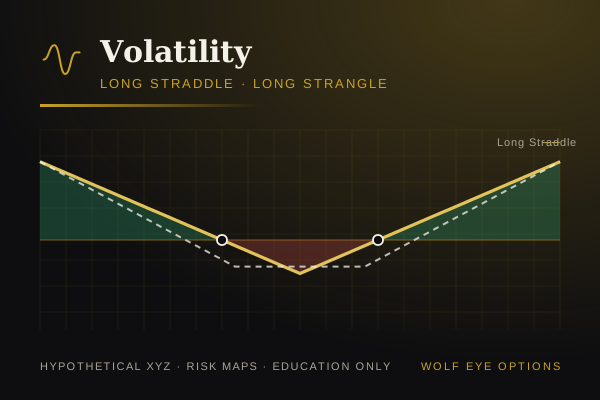
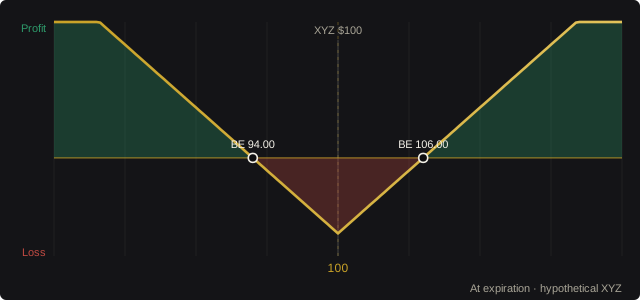
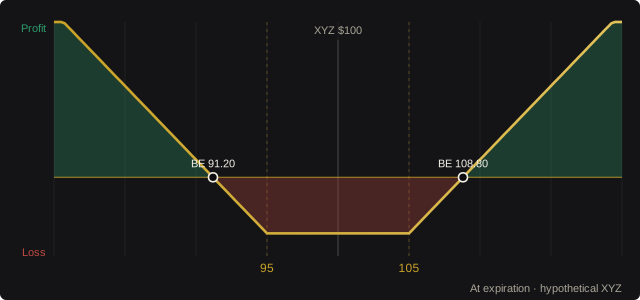
A long straddle or strangle does not care which way the stock goes. It needs the move to be bigger than what the market already priced in. That last part is where most volatility trades are won or lost, and it is what this category teaches you to measure.
Built for traders who want the worst case known first
Volatility structures are popular around earnings and big macro dates. They are also easy to overpay for. The goal here is to understand implied volatility well enough to know when a big move is already in the price.
You expect a large move around a catalyst but do not have a directional edge
You want to understand why a correct "big move" call can still lose money
You want to compare the breakevens of a straddle to the stock's typical move
You trade around earnings and want to understand implied volatility crush
Every structure below is drawn as a risk map before a single number is discussed.
What is inside
Two ways to buy a big move
Both lessons include the implied-versus-typical move comparison, so you can judge whether the price of the move is reasonable before you pay it.
On the daily list, volatility ideas are usually satellites: half size, sitting next to directional ideas rather than replacing them. The rules that carry over to straddles and strangles:
Compare breakevens to the stock's typical move over the same window before buying
Treat the max loss as the full debit and size to it
Plan the exit around the event: after a print, take the result the same day or next open
Half size is normal for a volatility or hedge idea
The Wolf Eye rules
Know the worst case first. Max loss in dollars, before entry.
Size off the max loss. 0.5% to 1% of the account per idea.
Write the exit before the entry. Kill a failed thesis at the close.
Bucket correlated names. 1% to 1.5% total.
How it fits
How this category fits the Wolf Eye path
The free Glossary and video introduce implied volatility and the volatility branch of the map. The Options Courses Pack ($297) teaches both structures in full alongside the range-bound trades that take the other side. The Service shows when, and how rarely, a volatility idea earns a slot on the 2pm list.
Why do straddles lose after earnings even when the stock moves?
Because implied volatility usually drops after the event. If the move is smaller than the market had priced in, the loss of extrinsic value can outweigh the gain from the move.
Straddle or strangle?
A straddle costs more but needs a smaller move. A strangle is cheaper but needs a bigger one. The lessons walk through how to choose using the breakevens.
Is this investment advice?
No. Everything on this page and inside the products is education and research. Examples use a hypothetical ticker, XYZ. You decide what, if anything, fits your own account.
What happens after the $9 trial?
The trial runs for 3 days. After that it continues at the plan shown on the checkout page unless you cancel before it ends. Full plans are $97 per month or $997 per year; see the Service page.
Education disclaimer. Wolf Eye Options is an education and research publication. Nothing on this page is investment advice, a recommendation, or an order to buy or sell any security, and nothing here is personalized to your situation. Options involve substantial risk and are not suitable for every investor; an option can expire worthless and you can lose the entire premium paid, and some structures (such as covered calls and cash-secured puts) carry the downside risk of owning stock. All trade examples are hypothetical, use the placeholder ticker XYZ, ignore commissions, fees and assignment risk, and are shown only to explain structure and risk. No results, returns, or win rates are claimed or implied. Before trading options, read Characteristics and Risks of Standardized Options published by the OCC, and consider consulting a licensed professional.