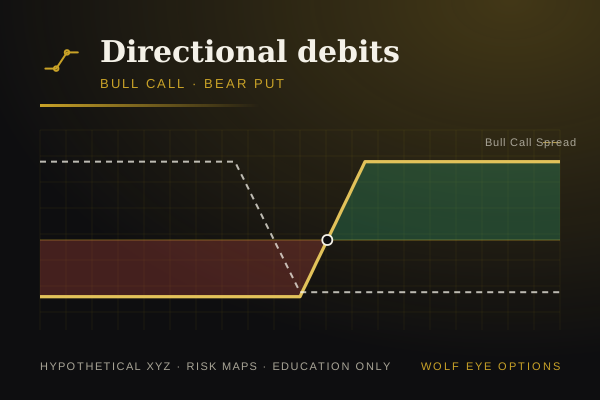
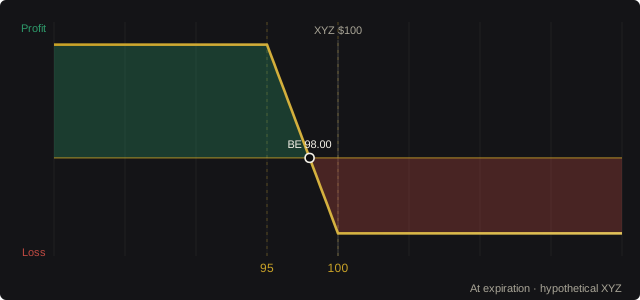
The bull call spread and the bear put spread are how we express a directional view without paying for every ounce of time and volatility. Known debit, known max loss, known target. It is the default structure on our daily Ideas list for a reason.
Built for traders who want the worst case known first
You have an opinion on direction, up or down, and a rough target. What you want is a structure that matches that view and cannot cost more than you decided up front.
You have bought calls or puts and watched time decay eat a trade that was moving your way
You want sizing to be arithmetic: risk 0.5% to 1% of the account, divide by the debit, done
You would rather trade a reasonable target than pay for a long-shot tail
You want to read the daily 2pm Ideas list and understand every structure on it
Every structure below is drawn as a risk map before a single number is discussed.
What is inside
Two structures, one idea
Every lesson covers construction, strike and width selection, expiration choice, the risk map, and management. The hypothetical examples below show the core numbers.
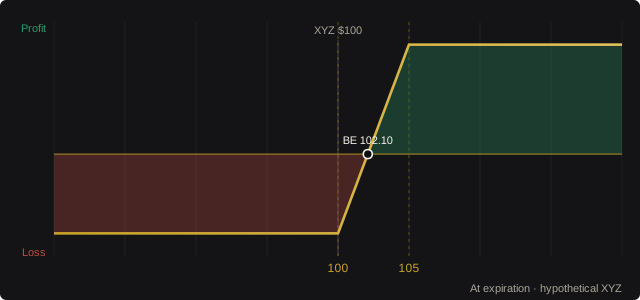
Buy a call, sell a higher-strike call, same expiration. The short call pays for part of the long call, lowering cost and breakeven in exchange for a capped upside.
Use it when: you expect a move up toward a specific level within the expiration window, and you would rather not pay full price for a single long call.
Hypothetical · XYZ at $100
Structure
Buy 100 call / sell 105 call, 30 days
Net debit
$2.10 ($210)
Max loss
$210, below $100 at expiration
Max gain
$290, at $105 or higher
Breakeven
$102.10
What kills it: the stock stalls or reverses before expiration; holding to the last week for the final few cents of value.
Debit verticals are the default on the Wolf Eye daily list. A naked long option only shows up when a vertical is not available or the debit is tiny and the clock is short. Every idea carries a tag in the same format, so you can size it in seconds:
Risk: 0.5% · Vertical: 100C / 105C · Bucket: single
Risk 0.5% to 1% of the account per idea, measured as the full debit
Three to five ideas from a list, not all of them
Correlated names share one bucket, sized 1% to 1.5% total
Scale out around half when the spread is worth 50% to 70% of max value
Kill the idea at the close if the thesis breaks; after an event, take the result the same day or next open
The Wolf Eye rules
Know the worst case first. Max loss in dollars, before entry.
Size off the max loss. 0.5% to 1% of the account per idea.
Write the exit before the entry. Kill a failed thesis at the close.
Bucket correlated names. 1% to 1.5% total.
How it fits
How this category fits the Wolf Eye path
The Field Manual introduces the debit vertical for free. Starter Week ($36) spends two full days on these two structures. The Options Courses Pack ($297) covers them alongside 18 other strategies, and the Service applies them to the live market every trading day.
Sometimes that is the right call, for example when the debit is tiny and the timeframe is short. But for most directional views with a target, a vertical costs less, breaks even closer, and caps the loss at a number you chose.
How do I pick the width?
Width sets max value and cost. Wider spreads cost more and have more room; narrower spreads are cheaper but cap sooner. The lessons cover how to match width to your expected move.
Is this investment advice?
No. Everything on this page and inside the products is education and research. Examples use a hypothetical ticker, XYZ. You decide what, if anything, fits your own account.
What happens after the $9 trial?
The trial runs for 3 days. After that it continues at the plan shown on the checkout page unless you cancel before it ends. Full plans are $97 per month or $997 per year; see the Service page.
Education disclaimer. Wolf Eye Options is an education and research publication. Nothing on this page is investment advice, a recommendation, or an order to buy or sell any security, and nothing here is personalized to your situation. Options involve substantial risk and are not suitable for every investor; an option can expire worthless and you can lose the entire premium paid, and some structures (such as covered calls and cash-secured puts) carry the downside risk of owning stock. All trade examples are hypothetical, use the placeholder ticker XYZ, ignore commissions, fees and assignment risk, and are shown only to explain structure and risk. No results, returns, or win rates are claimed or implied. Before trading options, read Characteristics and Risks of Standardized Options published by the OCC, and consider consulting a licensed professional.