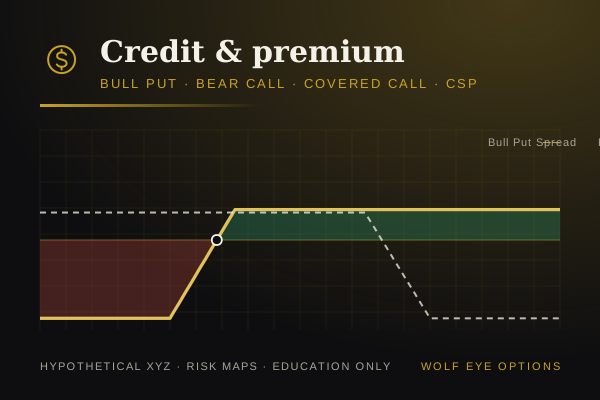
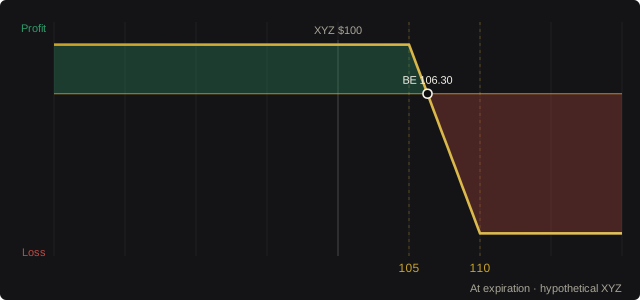
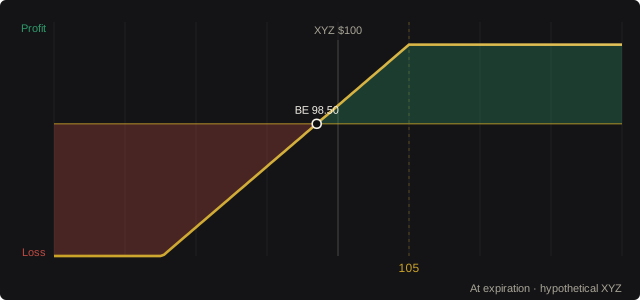
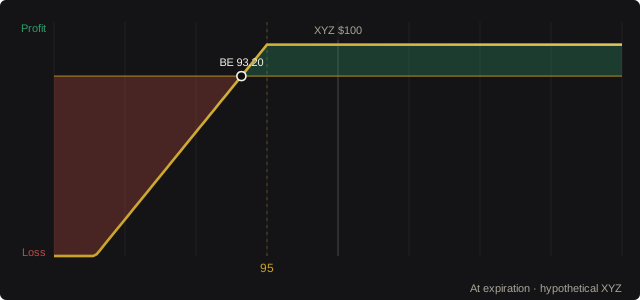
Bull put spreads, bear call spreads, covered calls, and cash-secured puts all collect premium up front. That premium is not a paycheck. It is compensation for a specific risk, and this category teaches you to see that risk clearly before you sell.
Built for traders who want the worst case known first
Premium selling is popular because it often works quietly for a while. The problem is that the risk-to-reward is upside down: you collect a little to risk more. That only works with tight structure and honest sizing.
You own stock and want to understand selling calls against it, including what you give up
You are considering cash-secured puts as a way to get paid while waiting to buy a stock
You want to sell premium with a defined maximum loss using credit verticals
You have been told premium selling is "income" and want the real math instead
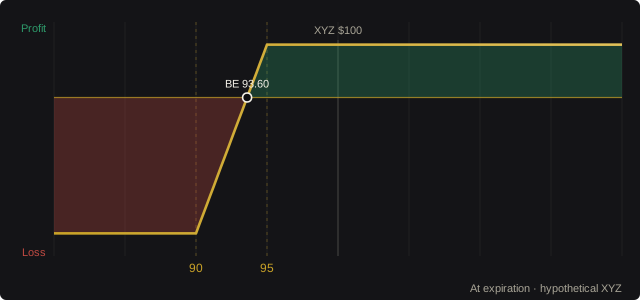
Every structure below is drawn as a risk map before a single number is discussed.
What is inside
Four ways to collect premium
Two of these, the credit verticals, are defined-risk. Two, the covered call and cash-secured put, carry the downside of owning stock. The lessons are explicit about which is which.
We never call premium income. Collecting $140 to risk $360 can be a sound trade, but only when the odds, the calendar, and the size line up. These are the rules the lessons drill:
Size off the max loss, never off the credit
Know the event calendar: earnings and macro prints can jump over a short strike
The protective wing on a credit vertical is never optional
Close or roll a tested side early rather than hope it comes back
Only sell puts or calls on stock you would genuinely own or sell at the strike
The Wolf Eye rules
Know the worst case first. Max loss in dollars, before entry.
Size off the max loss. 0.5% to 1% of the account per idea.
Write the exit before the entry. Kill a failed thesis at the close.
Bucket correlated names. 1% to 1.5% total.
How it fits
How this category fits the Wolf Eye path
The Field Manual introduces the credit vertical for free. Starter Week ($36) covers bull put and bear call spreads in depth. The Options Courses Pack ($297) adds the covered call and cash-secured put lessons, plus the rest of the 20-strategy curriculum. The Service shows how premium structures fit into a daily book.
Not inherently. They usually have a higher chance of a small profit and a lower chance of a larger loss. Over time, both the odds and the payoff matter. The lessons show how to compare them honestly.
Is a covered call defined-risk?
No. You still own the stock, so the downside is the stock's, reduced only by the premium. We teach it because many traders own stock, but we label the risk plainly.
Is this investment advice?
No. Everything on this page and inside the products is education and research. Examples use a hypothetical ticker, XYZ. You decide what, if anything, fits your own account.
What happens after the $9 trial?
The trial runs for 3 days. After that it continues at the plan shown on the checkout page unless you cancel before it ends. Full plans are $97 per month or $997 per year; see the Service page.
Education disclaimer. Wolf Eye Options is an education and research publication. Nothing on this page is investment advice, a recommendation, or an order to buy or sell any security, and nothing here is personalized to your situation. Options involve substantial risk and are not suitable for every investor; an option can expire worthless and you can lose the entire premium paid, and some structures (such as covered calls and cash-secured puts) carry the downside risk of owning stock. All trade examples are hypothetical, use the placeholder ticker XYZ, ignore commissions, fees and assignment risk, and are shown only to explain structure and risk. No results, returns, or win rates are claimed or implied. Before trading options, read Characteristics and Risks of Standardized Options published by the OCC, and consider consulting a licensed professional.